
Dive Deep with Dr. G — a teaching session with Dr. Glenn Hill, adapted for the Connection Codes blog.
You catch somebody after church, in the last minutes before everyone disappears into the parking lot. They have been holding something all week, and they finally let it out: you have been afraid all week.
A hand on your shoulder. "Don't be afraid. Just trust God." A verse. A short prayer. Forty-five seconds, and they walk away believing they helped. You walk away still afraid — and now carrying a second feeling: that being afraid means your faith is failing.
This is not a story about a bad person, or a bad church. It is about what we do when we do not know what to do with a feeling — and what happens inside the person trying to help.
That question became the first episode of Dive Deep with Dr. G. Dr. Glenn Hill, who started Connection Codes with his wife, Phyllis, answered it on camera. We love the Church, and we believe the verses people quote. Glenn says he did not recognise what was happening inside himself for a long time, and used to judge the leaders he now helps. This is written from inside the family.
We have been teaching this for centuries
Glenn's first answer was about time. "We've been teaching this for centuries," he said, "literally, many centuries." In the fourth century, a monk named Evagrius Ponticus wrote down eight patterns of evil thought a Christian had to fight. Anger was on the list. So was sadness. About two hundred years later, Pope Gregory the Great reworked that list into the seven deadly sins. Evagrius meant a particular kind of sadness — the brooding kind that grows out of frustrated desire — and he was writing for monks. Lists travel without their fine print. Plenty of Christians have absorbed the simpler version: that some feelings are sins. Set that beside Jesus in Gethsemane, who said, "My soul is overwhelmed with sorrow to the point of death. Stay here and keep watch with me" (Matthew 26:38, NIV). He named his sorrow out loud, and asked his friends to stay.
"The joy of the Lord is your strength" — said to people who were weeping
The verse used as the standard answer to sadness is: "Do not grieve, for the joy of the Lord is your strength" (Nehemiah 8:10, NIV). It sounds like a command to stop feeling sad. The scene shows something different.
In Nehemiah 8, exiles home from Babylon gather while Ezra reads God's Law aloud, from early morning until midday. Many start to cry. The leaders say: "This day is holy to the Lord your God. Do not mourn or weep. Go and enjoy choice food and sweet drinks, and send some to those who have nothing prepared" (Nehemiah 8:9–10, NIV).
Why did they stop crying, then cry again three weeks later?
Because it was a feast day, not a "never cry" day. That day was holy for celebrating together — so the leaders said, don't mourn today, go eat together and share food with people who have nothing. Then, three weeks later, the same community set aside a whole different day to grieve: "On the twenty-fourth day of the same month, the Israelites gathered together, fasting and wearing sackcloth and putting dust on their heads" (Nehemiah 9:1, NIV). A whole day to mourn, together and out loud.
Joy and grief were neighbours — joy on the feast day, grief three weeks later. Nobody cancelled their grief. They gave it its own day. That is the part most of us have never heard: the verse was not "stop feeling sad forever." It was "not today — today we celebrate together, and grief gets its own day."
Why a leader reaches for the quick answer
Glenn does not think most leaders mean harm. "Humans are messy," he said, and it is "a lot easier just to very quickly tell people, just stop it." He also named what happens inside the listener: "When you share with me your pain, I feel pain. I don't like pain." Bring someone your fear, and it stirs up fear in them. They want it gone fast.
Your pain registers in their brain as pain.
Researchers have seen this in a scanner: watching a partner receive mild electric shocks activated the watcher's own pain-feeling brain areas, much as receiving the shock did (Singer et al., 2004). The study did not show that they feel your exact fear — it showed empathy for pain, in the affective, feeling part of the brain, not the sensory, touch part. Scientists still debate the mechanism, but the finding holds: other people's pain does not stay entirely theirs. That is why the quick verse is so tempting — sitting with your pain hurts the listener too, in a literal, measurable way.
That is why the verse and the prayer are so tempting. They are fast, clean, and they end the conversation. Staying asks the leader to be present with their own feelings first. "But the reality is, you can be present with somebody," Glenn said, "but you've got to get good at being present with yourself." Many leaders have told Glenn they are frustrated that so much of their time goes to people's emotions. He used to judge them for that, and does not anymore. A pastor never shown what to do with an emotion will do what any of us would do with a hot pan — put it down fast. The feeling does not stop. "They might not share it with you, they may not share it with anybody, but it doesn't mean that it stops."
Slower is faster
"Most people think that faster is faster," Glenn said. The forty-five-second exchange felt fast. "I patted them on the back, I gave them a scripture, I said a prayer over them. There you go." That version, Glenn said, takes "hours, days, weeks, who knows, months, years," because the feeling never moved.
The slower version is: stop, stay present, make it safe, help the person put words to what is happening inside them. Glenn says that when someone is met that way, the emotion can move through in thirty to forty-five seconds — his teaching number, from his work with couples and leaders, not a lab timing. He did not know that was possible until he became a Connection Coder, not that many years ago.
After church, it can sound like this: the other person says they have been afraid all week. Instead of a verse, first an "Oooo," then, "That sounds like a heavy week. What happens for you when you think about it?" Then listen. Glenn uses "what," not "why," because "why" sounds like an accusation. We have taught that "Oooo" in full in "Jesus Wept" and "The Cost of Not Crying." What matters here is where it sits: before the verse and before the prayer, not instead of them. After the person has been heard, prayer lands as care instead of as a way to finish.
Should I leave my church?
Glenn would not answer that for anyone. "I'm not gonna make that call," he said. He is not recommending that anyone leave. He was also honest that some situations are toxic. When leadership treats the suppression of feelings as doctrine, Glenn said, "there may be scenarios where you simply can't function and you need to be in a different situation."
Whatever you decide, Glenn wanted one thing settled first. Your permission to have feelings does not come from a pastor, a small group, or a denomination. "They don't give you the permission to be human," he said. "You already have that permission. You received it from birth, or before."
One thing to try: ask for help, not agreement
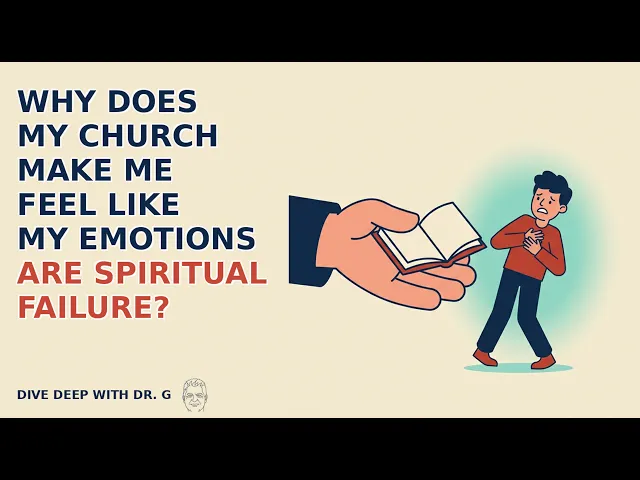
If you would like your church to handle emotions differently, do not walk up to a leader, hand them a book, and say they need to read it. "That's a tough sell," Glenn said. "Nobody likes that." Ask for their help instead: "I need your help. This has really struck me. I've learned a few things, and I could really use your help in this."
Asking for help changes the conversation. You are not correcting them. You are inviting them to work on something alongside you, and most leaders find that much easier to say yes to. It does not always work, but Glenn has seen churches, businesses and other organisations change because one person said, "Could we talk about this? Could we partner together in making this part of our culture?"
This week, pick one leader you trust and have that conversation. Not a debate. Not a book handover. A request for help.
So when you next bring a hard feeling to someone at church, or someone brings one to you, what would it look like to mourn with them for a minute before anyone reaches for a verse?
Watch the full Dive Deep episode
. For words for what you have been feeling, start with our free Core Emotion Wheel: https://connectioncodes.co/cew.
Further reading: "Can I Trust My Feelings?", "God Never Asked You to Stop Feeling It", "Jesus Wept", "Joy Is Not Your Green Light", "The Cost of Not Crying".
References
Singer, T., Seymour, B., O'Doherty, J., Kaube, H., Dolan, R. J., & Frith, C. D. (2004). Empathy for pain involves the affective but not sensory components of pain. Science, 303(5661), 1157–1162. https://doi.org/10.1126/science.1093535
Scripture quotations are from the New International Version (NIV).
Loading the thread…
Share what landed, what you're sitting with, or what you'd push back on. Be kind.
Editorial sign-in